
Keeping Kids Safe: Stories from 40 Years — A Conversation with Dr. Dave Campbell, Founder and President Emeritus of IFM Community Medicine
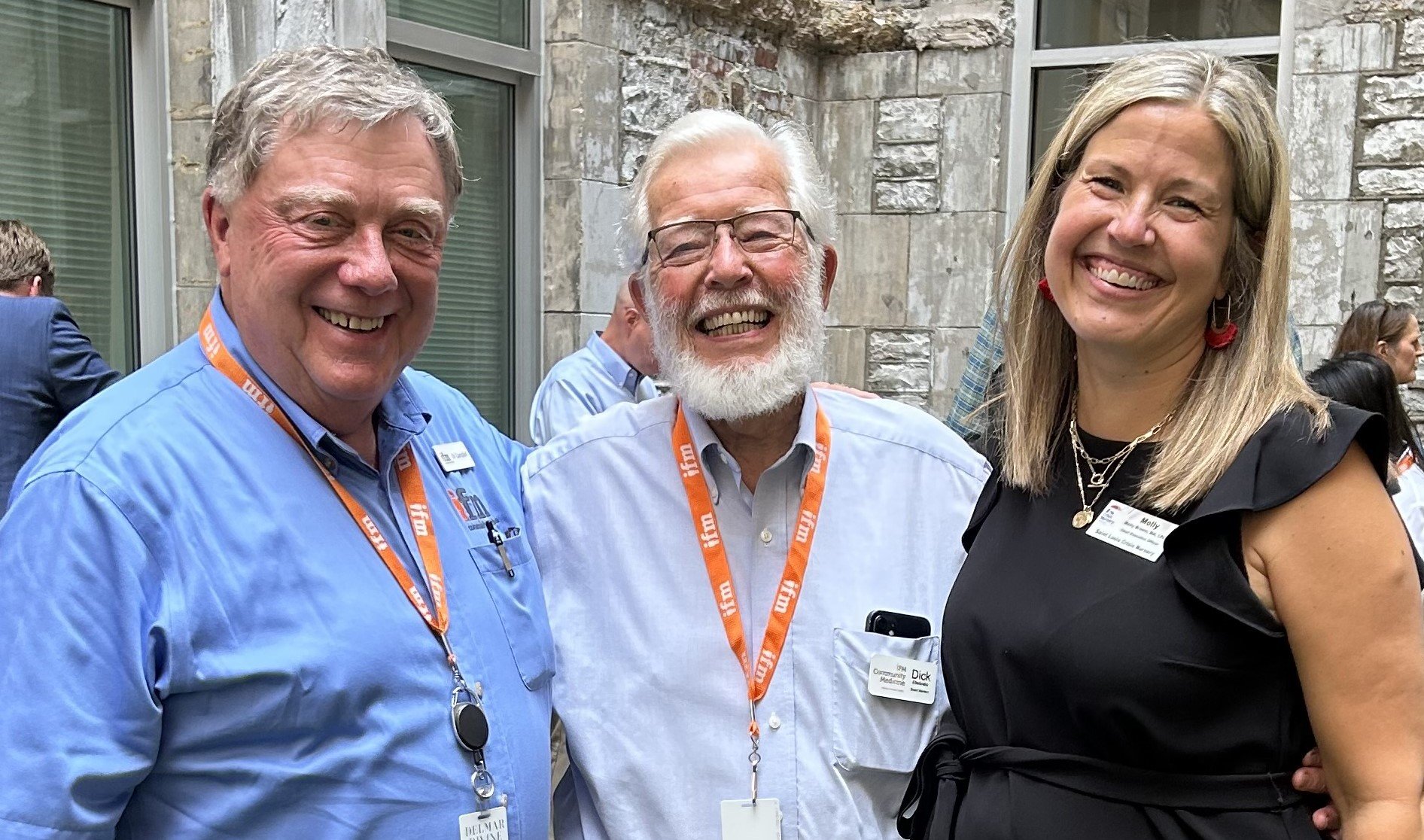
Dr. Dave Campbell with Rev. Richard Ellerbrake and CEO, Molly Brown
As the Saint Louis Crisis Nursery celebrates 40 years of Keeping Kids Safe and Building Strong Families, we are reflecting on the partnerships that have helped make our mission possible.
For decades, the Nursery has partnered with IFM Community Medicine to ensure children in our care have access to medical services when they need them most. Through this collaboration, children receive health screenings, treatment for acute concerns, referrals to specialty care, and compassionate support that addresses their overall wellbeing.
Today, we're honored to share a conversation with Dr. Dave Campbell, Founder and President Emeritus of IFM Community Medicine. His connection to the Crisis Nursery dates back nearly four decades, and his reflections offer insight into the critical role healthcare plays in supporting children and strengthening families during times of crisis.
**********
For many years, IFM has partnered with the Crisis Nursery to provide medical care to children in our program. From your perspective, why is it so important that children in crisis have immediate access to healthcare as part of that support?
Dr. Campbell: “My personal involvement with the Crisis Nursery dates back to 1987 when I was developing the family residency program at Deaconess. I supervised residents who completed admission physicals and addressed acute medical concerns that arose. A few years after I left Deaconess, DiAnne Mueller reached out because the original model of locating the Nursery within a hospital was no longer working as intended, and access to medical care had become more limited.
Originally, every child was seen because residential facilities were required to complete a screening physical upon admission. What we found, however, was that many children arriving at the Crisis Nursery had unmet health needs. When a family is experiencing crisis, healthcare concerns can understandably take a backseat. In addition to acute illnesses, we often identified gaps in routine screenings, including growth and development assessments, hearing and vision screenings, and other preventive care.
The partnership between IFM and the Crisis Nursery allows many of these needs to be addressed. In some cases, previously undiagnosed chronic illnesses are identified, and we are able to connect families with specialty care and additional medical support.”
How do you see the connection between a child's physical health and the prevention of abuse or deeper family crisis?
Dr. Campbell: “Issues with a child's physical health can become a significant stressor for families. For a family already struggling with life challenges, a medical issue can be the thing that pushes them beyond their ability to cope. Unfortunately, in moments of extreme stress, parents may react in ways that are out of character, and situations can quickly escalate. Addressing health concerns early can help reduce that stress and create stability for both children and caregivers.”
Through your partnership with the Nursery, what have you seen or experienced that has stayed with you—something that reflects the importance of this work?
Dr. Campbell: “One thing that impacts me—and in some ways makes me sad—is realizing that for many children, being at the Crisis Nursery may be their best day. A comfortable bed, good meals, toys to play with, and people who hold them and show them love is not something every child experiences consistently.
While that reality is difficult, I find hope in knowing that the Nursery's wraparound services are working to break that cycle. The support provided to families creates opportunities for children to experience greater stability, safety, and care beyond their time at the Nursery.”
The Nursery focuses on meeting families where they are—emotionally, practically, and relationally. How does access to compassionate, low-barrier medical care fit into that bigger picture of supporting the whole family?
Dr. Campbell: “Compassionate and low-barrier are words that describe all of the Crisis Nursery's services. Families quickly learn that the Nursery is a place where they can receive help in a supportive and nonjudgmental environment.
Providing medical care within that same atmosphere is important. For many families, the experience is very different from what they may have encountered in emergency rooms or large public clinics. When healthcare is delivered in a trusted setting, families are often more comfortable seeking help and following through with care.”
Many families face barriers to healthcare, especially during moments of stress or crisis. How does bringing medical care directly into a setting like the Nursery change outcomes for children and parents?
Dr. Campbell: “The IFM model is built around addressing the barriers that often prevent underserved families from accessing healthcare.
The first barrier is transportation. We go where patients already are, which in this case means providing care directly at the Crisis Nursery.
The second barrier is cost. Through our partnership with the Nursery, care is provided at no cost to families.
The third barrier is trust. Many families have had difficult experiences with traditional healthcare systems. By partnering with an organization that families already know and trust, healthcare providers are able to build on those existing relationships and provide care in a more effective way.”
When you think about child abuse prevention, what role do healthcare providers and community partners play in supporting families before situations escalate?
Dr. Campbell: “When people think about healthcare providers and child abuse, they often think about mandatory reporting. While that role is important, prevention begins much earlier.
The goal is to recognize concerns and intervene before situations reach the point of visible injuries or abuse. That often requires experience, intuition, and a nonjudgmental approach. Healthcare providers and community organizations both have a responsibility to identify stressors, offer support, and connect families with resources before a crisis deepens.”
As we look to the future, what gives you hope about how organizations like IFM and the Crisis Nursery can continue working together to strengthen families and keep children safe?
Dr. Campbell: “We have a track record. Both organizations have developed models that work, and there is mutual respect between our teams. That partnership has proven effective over time, and I believe it will continue to make a meaningful difference for children and families for years to come.”